"Not everything makes it to the finish line, but everything teaches a lesson. This is a collection of 24-hour hackathon sprints, material experiments, and visual thoughts that are too raw for a case study but too interesting to forget."
The Phenomenology of Relevance
WHAT if?
Convincing the Inaudible
GovJam
Thirst : Water Crisis
Dec 6, 2024
WHAT if?
Zoning In: Speculative Scenarios
'WHATif?' is a series that questions probable futures peeking through the walls of reality. While drifting away in thoughts, as a designer I understand that some of them are beyond possibilities within the working realities we live in today. Yet, this series attempts to discourse on some speculative thought experiments that might not be immediately feasible, yet imaginable.
I believe Imagination holds the power to inspire technological advancements that bring about innovation. Some ideas are revolutionary while some are thought-provoking.
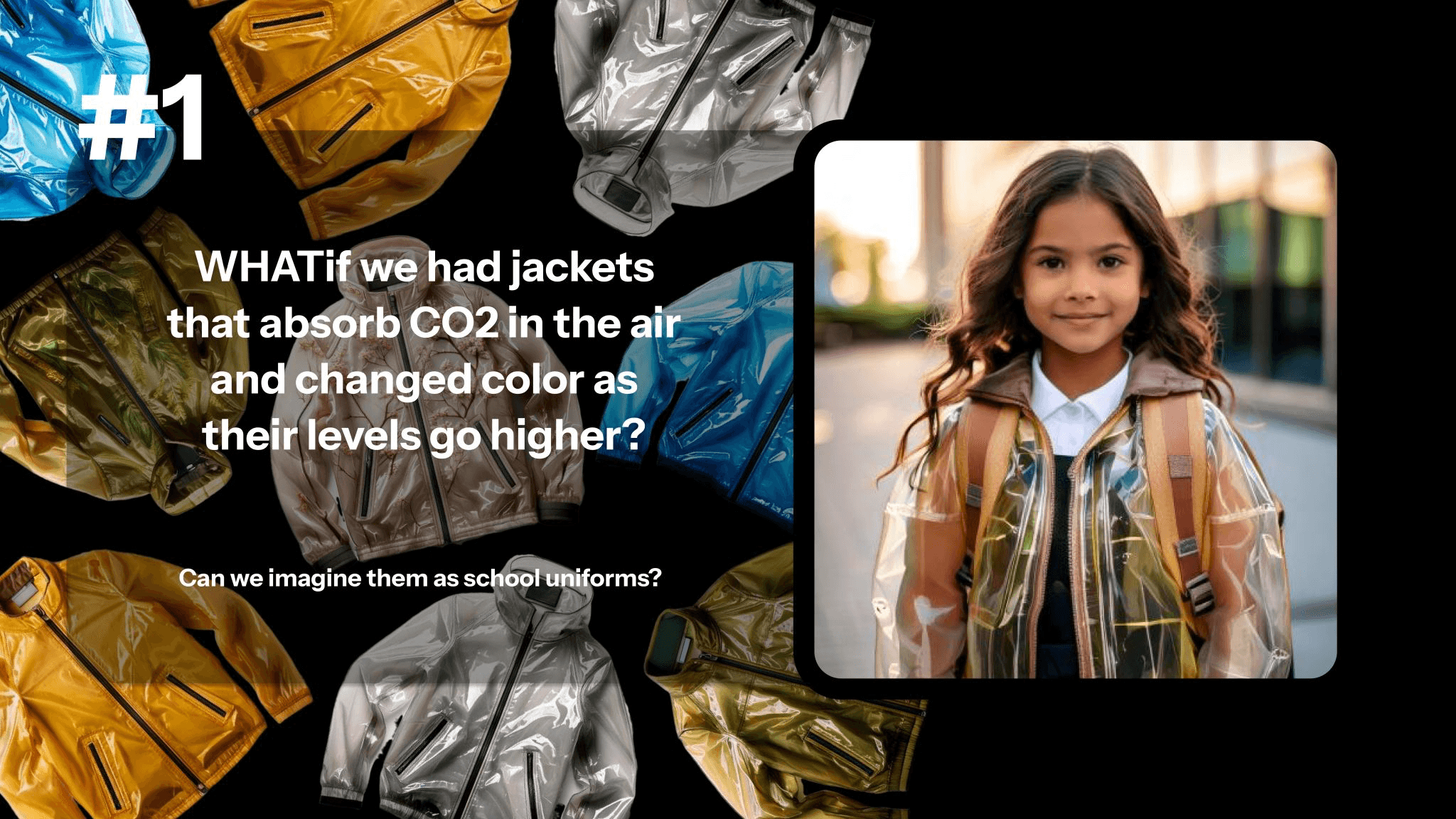
So, What if we had jackets that absorb CO₂? Is it possible?
Lets see how that could work:
🦠 CO₂ - Absorbing Material: The fabric could be treated with a special coating or have embedded fibres that capture CO₂. Research in algae-infused textiles or reactive minerals like calcium oxide (which can absorb CO₂ when in contact with moisture) could offer inspiration. Another route could be using porous materials or metal-organic frameworks (MOFs), which are known for their ability to capture CO₂ at high rates.
🌈 Colour-Changing Mechanism: The jacket could incorporate thermochromic or electrochromic pigments that change colour in response to CO₂ concentration changes. The colour change might be triggered by a chemical reaction within the jacket material itself or by CO₂ sensors embedded in the fabric that send electrical signals to the colour-changing elements.
🍁 Visual Feedback: Imagine sections of the jacket, like panels or pockets, shifting from green to yellow to red based on CO₂ concentration in the surrounding air. This feedback would allow wearers to see the air quality in real time, and it would make a bold statement in social and urban spaces.
🌵 Regeneration Feature: For sustainability, the jacket could have a way to regenerate itself, like a process where the CO₂ is released when exposed to sunlight in summers, allowing the material to be reused. This could make it practical for daily wear without becoming saturated.
🖲️ Technologies for Integration: Wearable tiny CO₂ sensors can be embedded into textiles for real-time monitoring and triggering reactions. Another possibility could be nanoparticles with functionalized coatings that can improve efficiency for both absorption and colour response.
Could such a design merge the concept of multifunctional clothing to make rising CO₂ levels visible, inspiring people to contribute to cleaner air and embrace sustainable practices?