"Not everything makes it to the finish line, but everything teaches a lesson. This is a collection of 24-hour hackathon sprints, material experiments, and visual thoughts that are too raw for a case study but too interesting to forget."
The Phenomenology of Relevance
WHAT if?
Convincing the Inaudible
GovJam
Thirst : Water Crisis
Mar 24, 2025
The Phenomenology of Relevance
Mapping the Invisible Shifts in Collaboration
While reflecting on the values that make collaboration truly effective, I kept returning to Charles Handy’s organisational theories (1999), which we explored in depth during the collaborative unit project. What stayed with me wasn’t a single framework, but the idea of organisations, and by extension, teams as 'living systems'. Interconnected, non-hierarchical, and constantly reshaping themselves through relationships rather than rigid structures.
We often like to imagine projects as neat, linear journeys: Define the problem, research the context, Ideate a solution, Test its feasibility. But in practice, I’ve found that the success of a project is rarely decided by the process chart alone. Something more subtle is always at play.
This visual study is my attempt to map what I’ve come to think of as the Phenomenology of Relevance—those core moments within a project’s lifecycle that have the power to quietly, and sometimes radically, alter its trajectory. If a collaborative project is structured around four key stages - Problem definition, Contextual research, Solution ideation, and Feasibility assessment, then the relevance of ideas, insights, and even the direction of the project itself is shaped by a constant interplay of three forces: Assemblage, Context, and Time.
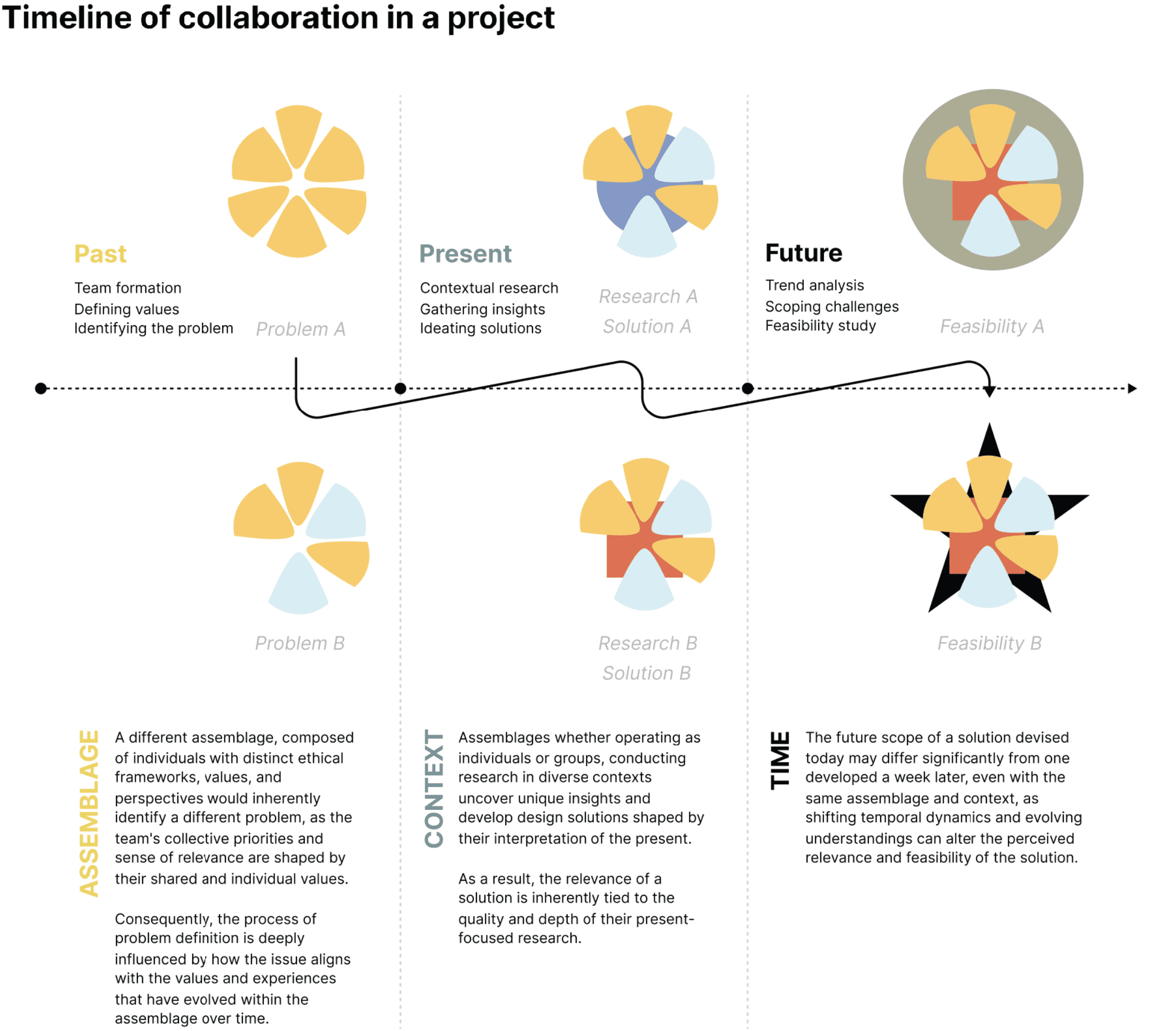
Assemblage refers to the composition and dynamics of the team - who is in the room, what they bring with them, and how power, trust, and authorship circulate. Context encompasses the environmental, cultural, and situational conditions surrounding the project. Time, meanwhile, is not just a deadline, but a living constraint - one that evolves as priorities shift, information emerges, and urgency changes.
Looking at a project through this lens, its lifecycle begins in the Past: the moment of team formation and problem framing. Decisions made here, often unconsciously, set the tone for everything that follows. In the Present, insights collide with interpretation. Research is filtered through personal experience, disciplinary bias, and collective negotiation. This is where friction lives, but also where meaning is made. The Future then emerges not purely from what is technically feasible, but from what feels relevant at that precise moment in time, socially, culturally, and emotionally.
What this reflection has made clear to me is that collaboration isn’t just about working together efficiently. It’s about navigating these invisible intersections where team values meet external reality, where timing reshapes intention, and where relevance is constantly being negotiated rather than fixed.
True collaboration, I’m learning, lives in those in-between moments .